One of the clearest governance gaps exposed by the 2026 South Australian state election is this:
a councillor can be a known parliamentary candidate — publicly endorsed, publicly campaigning, publicly associated with a party and electorate — and still continue in office until the legal leave trigger arrives.
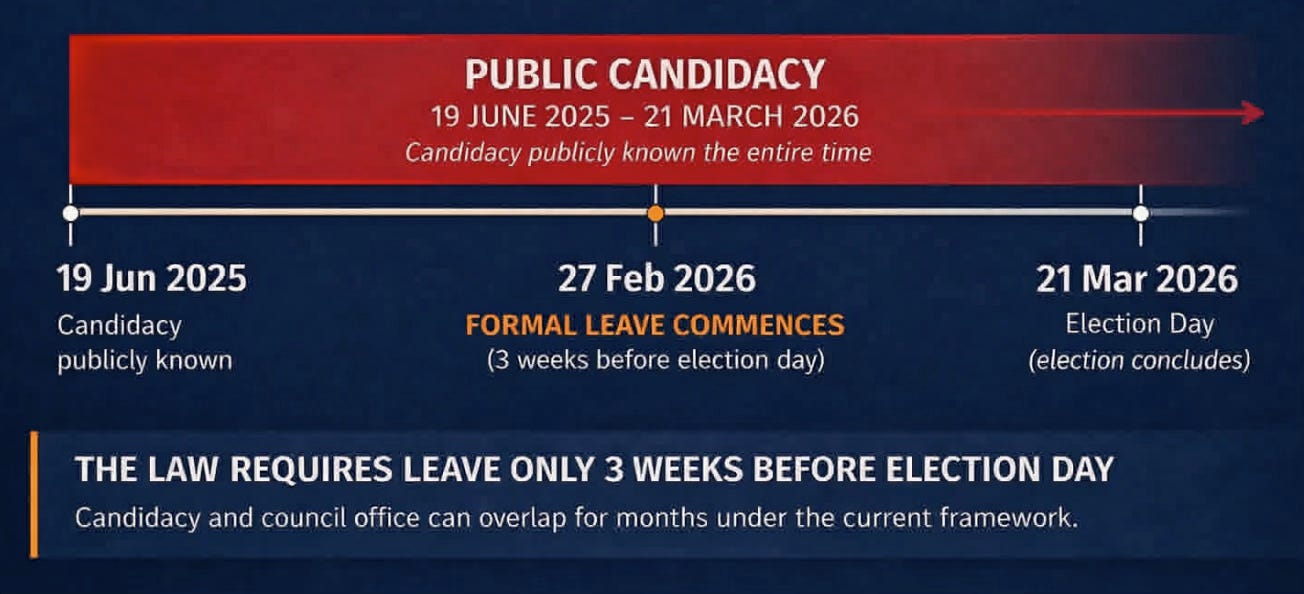
Mount Barker District Council explained the position plainly during the 2026 campaign: before 27 February 2026, councillors contesting the state election were still council members with their ordinary duties and obligations remaining in place. ECSA (Electoral Commission of South Australia) says the writs were issued on 21 February 2026, nominations closed on 2 March 2026, and polling day was 21 March 2026.
In practice, that meant the law did not require leave when candidacy became publicly known. It only bit later, once the formal election timetable was already underway.
That is the gap.
Not when a candidate is endorsed.
Not when a candidate is publicly announced.
Not when the community already knows they are running.
Only once the statutory election machinery reaches the relevant point.
Cr Marisa Bell, the City of Onkaparinga councillor for Southern Vales Ward, is a useful example of that gap.
Her candidacy for Heysen was publicly known by at least 19 June 2025, but formal leave did not begin until 27 February 2026 and ran until the election concluded on 21 March 2026. Bell had also been Labor’s candidate for Mayo at the 2025 federal election.
In other words, her state candidacy was public for months before the law required formal separation from council office.
Bell is a useful example for another reason too. The verified council minutes show repeated use of Questions on Notice and Notices of Motion on issues extending well beyond narrow ward matters, including:
Once Bell was a known parliamentary candidate, that record took on a different significance.
It raised the question of when formal council advocacy begins to overlap with parliamentary political positioning.
The overlap was not theoretical.
The minutes show Bell also continued to deliberate on matters with clear state-political or sector-advocacy relevance while she was a known candidate.
Earlier, she had also used a formal Question on Notice to pursue council’s role in national climate advocacy, including advocacy linked to COP31.
So the issue was not simply that a known candidate remained a councillor.
It was that a known candidate continued participating in matters overlapping with parliamentary inquiries, planning submissions and broader advocacy agendas while still exercising council office.
This was not isolated, and Cr Bell certainly isn’t the whole story.
We undertook a broader review of the 2026 South Australian state election candidate lists identified 24 candidates with local-government elected-member links, including councillors, deputy mayors and mayors across multiple parties and independents.
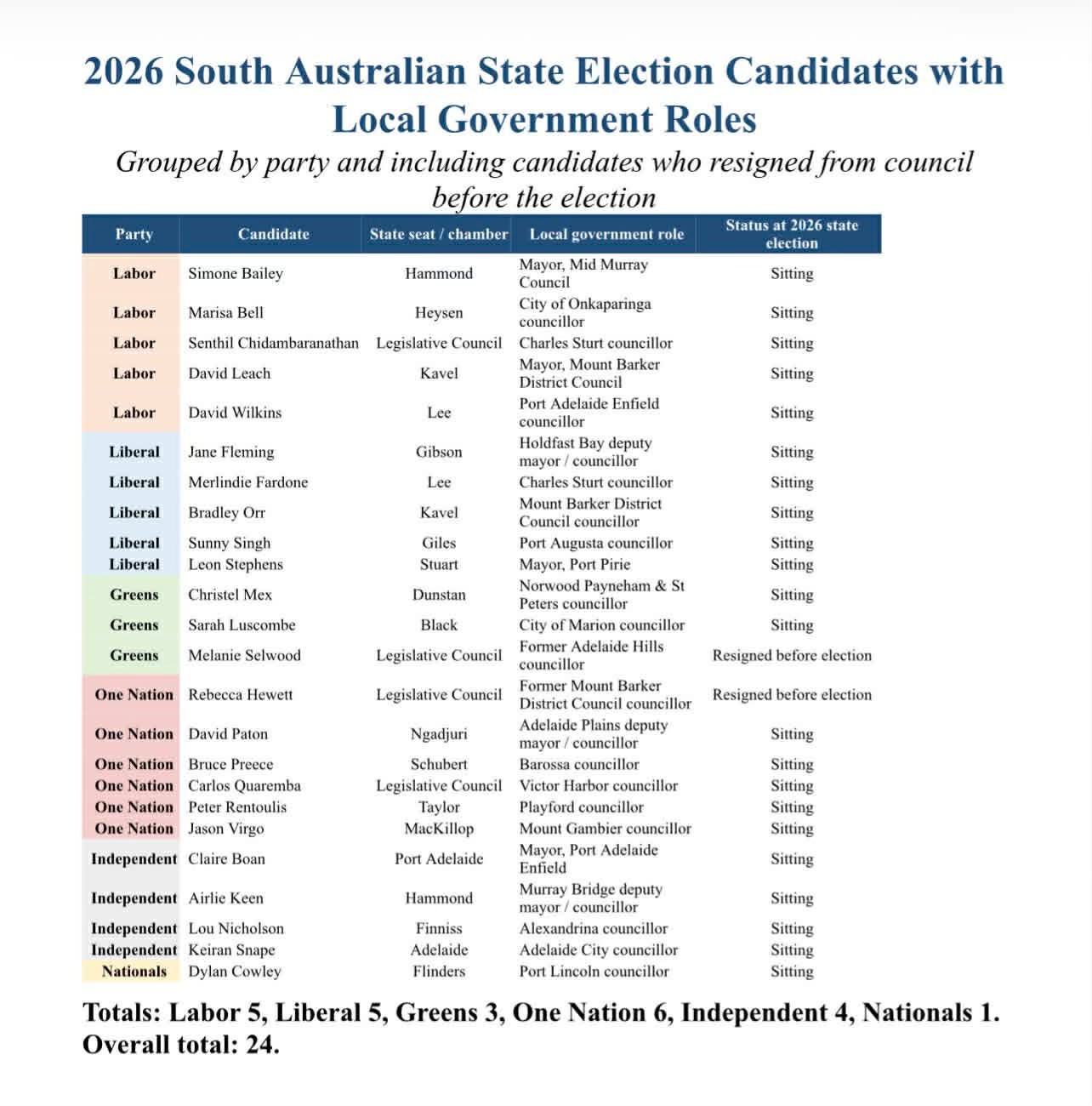
The contrast in how candidates handled the overlap is telling.
Melanie Selwood, the Greens’ lead Legislative Council candidate, resigned following Greens preselection. Adelaide Hills Council said so directly in its public statement.
Rebecca Hewett, also a One Nation Legislative Council candidate, resigned from Mount Barker District Council, with the Government Gazette recording her resignation as effective 3 November 2025.
Carlos Quaremba, by contrast, remained publicly identified as a City of Victor Harbor councillor during the election period. Victor Harbor’s council page continued to identify him as a councillor, while local reporting said he took leave of his local duties to stand as a Legislative Council candidate rather than resigning.
That inconsistency is part of the point.
The legislation did not require a clear, early and uniform separation once candidacy became public.
It allowed the overlap to be handled differently from one candidate to another.
This is the loophole.
It is not that councillors can run, the issue is that the law does not require a meaningful separation when an intent of candidacy has publicly been stated.
Instead, it waits for a later election-stage trigger. So a councillor can already be:
...and still continue in office with ordinary duties intact
That is exactly the kind of grey zone that weakens public confidence.
The public should not have to guess whether the person speaking, moving motions, asking formal questions or shaping advocacy is acting as:
This is a serious governance issue regardless of whether the conduct is framed as unlawful, or corrupt.
The problem is that the legislative framework permits an overlap between public office and parliamentary candidacy long after that overlap has become real, public and politically significant.
A legal framework that is supposed to protect confidence in public office should not wait until late in the election timetable before recognising what the public can already plainly see.
That is the real problem.
This is bigger than one councillor, one party, or one election. It is a structural problem in the law itself.
The law does not step in when candidacy becomes public, politically active and plainly relevant to the exercise of public office.
It steps in later.
By then, the overlap between council office and parliamentary ambition is no longer hypothetical. It is already underway.
When a person can be a known parliamentary candidate and still remain in council office until a later statutory trigger, the boundary has already blurred before the law even begins to respond.
That is what this election exposed.
The law does not prevent the overlap, it recognises it too late.
And that is the legislative gap between candidacy and leave.